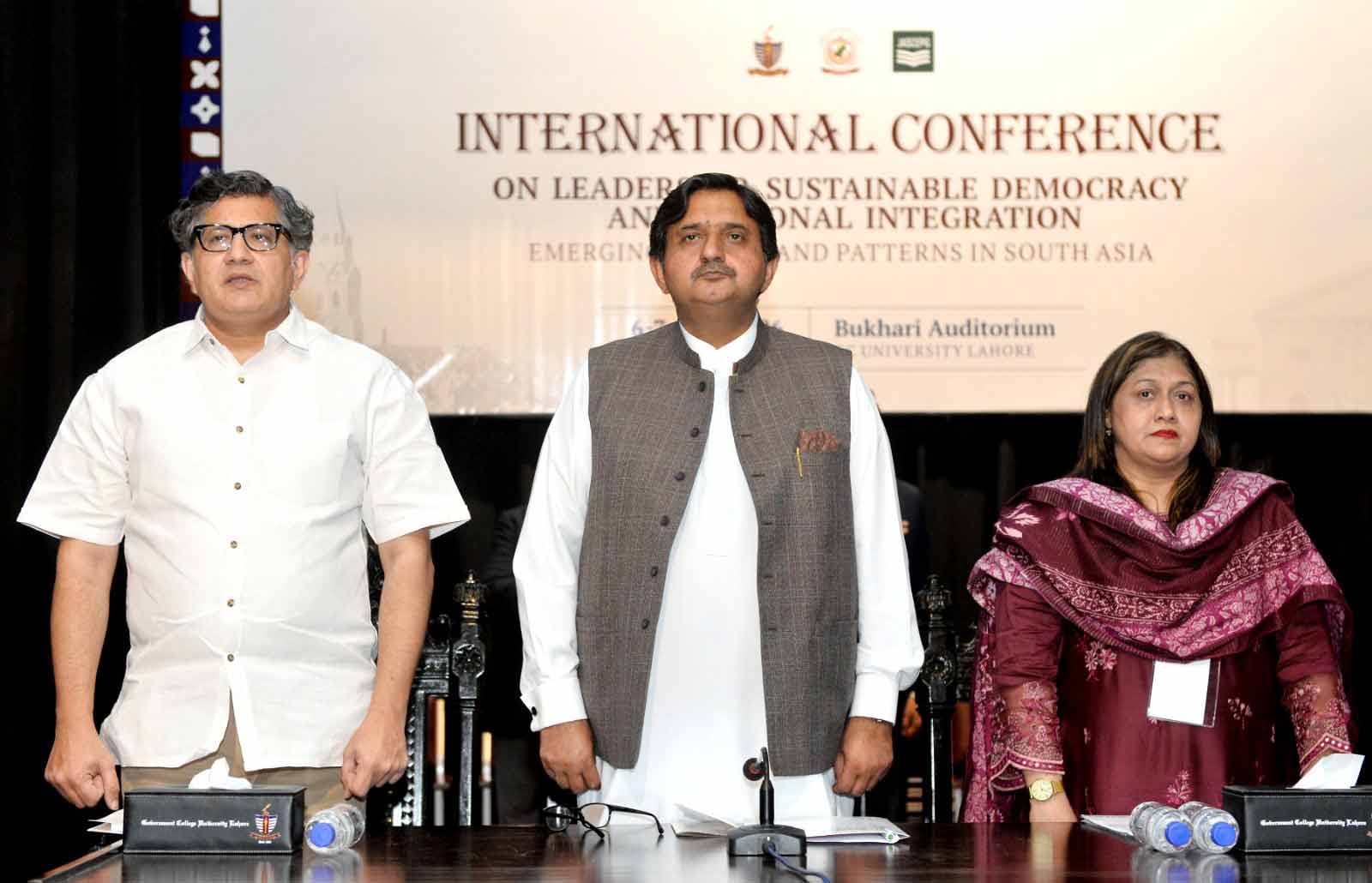
Academics warn AI, algorithms influencing Political Landscapes
Academics at an international conference at Government College University Lahore warned that artificial intelligence and digital algorithms are increasingly influencing national political landscapes, presenting a severe new challenge to South Asian democracies already hobbled by systemic governance issues and weak frameworks.
The two-day International Conference on Leadership, Sustainable Democracy and National Integration: Emerging Trends & Patterns in South Asia is organized by the Department of Political Science at Government College University (GCU) Lahore. GCU Vice Chancellor Prof. Dr. Muhammad Omer Chaudhry chaired the inaugural session of the conference spread over different technical and academic sessions.
In his keynote address, Speaker of the Provincial Assembly of Punjab and Old Ravian Malik Muhammad Ahmad Khan presented a candid assessment of Pakistan's governance deficits and urged future leaders to reject the "doctrine of necessity."
"I can fairly say our political history is marred with conflicts, is marred with uncertainty," the Speaker said. Acknowledging past institutional failures, he added, "We at times don't believe in elections, we don't comply with the fairness of elections, we don't adhere to the Constitution, we enforce martial laws, we make hybrid systems, and we do so many things, and our history is checkered with that."
He emphasized that institutional stability requires unwavering adherence to the rule of law. "The only way forward is upholding the Constitution," Ahmad Khan declared, adding that electoral acceptance and rejections should be based upon the Constitution alone and nothing else.
Highlighting modern technological challenges, Prof. Dr. Aatir Rizvi, Professor of International Relations and Director of the Asian Institute of Law, warned that digital ecosystems and social media are increasingly bypassing traditional institutional structures. "In this age of AI, the nations are built and destroyed through social media, and this we are observing and experiencing throughout the globe," Prof. Rizvi stated, questioning who bears ultimate responsibility for safeguarding democratic discourse in an unregulated digital landscape.
Addressing historical governance deficits across the region, Prof. Dr. Muqarrab Akbar, Chairman of the Political Science Department at Bahauddin Zakariya University, Multan, discussed the pervasive influence of individual-centric politics, populism, and power-seeking patterns. While contrasting regional institutional stagnation with transformative state-builders like Singapore’s Lee Kuan Yew, Prof. Akbar acknowledged long-term institutional evolution within Pakistan, noting consecutive, smooth transfers of power from 2008 to 2026. He reminded attendees that democratic maturity takes time, noting that established Western democracies required centuries to grant full voting rights across all demographics.
Examining the structural roots of systemic administrative challenges, Prof. Dr. Antoni Kaminski, Advisory Board Member to the Prime Minister of Poland, drew on international research and Poland’s post-1989 transition to discuss how administrative and political friction occurs. He stressed that constitutions must enforce a balanced separation of executive, legislative, and judicial powers to keep governance responsive to society.
In her welcome address, Department Chairperson Prof. Dr. Fouzia Ghani echoed the need for robust frameworks, emphasizing that sustainable democracy requires far more than periodic elections; it demands accountable institutions, judicial independence, free media, and a shift toward human security frameworks that address transboundary challenges such as climate change, water scarcity, and cyber vulnerabilities.
GCU Vice Chancellor Prof. Dr. Muhammad Omer Chaudhry connected these democratic principles to national integration, highlighting GCU’s legacy since 1864 in providing inclusive, borderless education free from regional or sectarian bias. Citing Nobel laureate Dr. Abdus Salam as an exemplar of this heritage, Prof. Chaudhry concluded that genuine leadership is demonstrated not by political speeches on a rostrum, but by the quiet, sustained work of building institutions and shaping a resilient generation.
The conference continues through Wednesday with parallel sessions covering media narratives, climate resilience, and regional geopolitics.